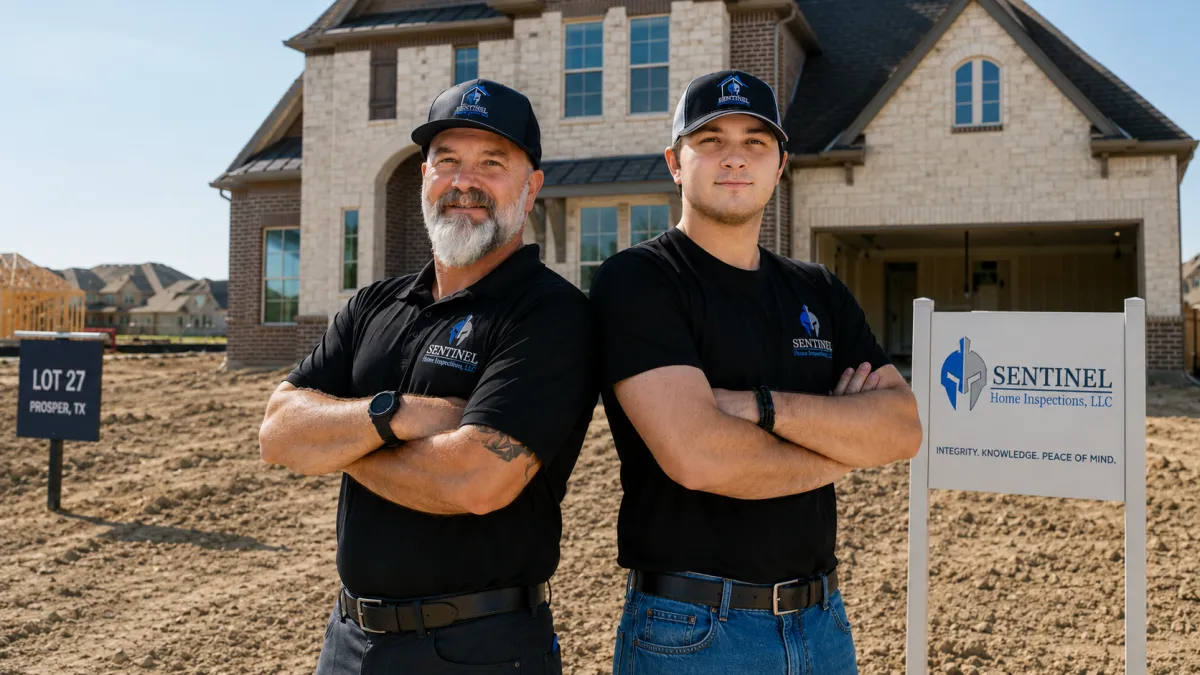
The Builder's Inspector vs. Your Inspector: What New Homebuyers in Prosper and Celina Need to Know
Drive through Prosper or Celina right now and you will see entire neighborhoods rising from the dirt in a matter of months. Collin County is one of the fastest-growing areas in the entire country, and production builders are moving fast to keep up with demand. That speed is great for inventory. It is not always great for quality control.
If you are buying a new construction home in one of these communities, at some point your builder is going to tell you something like this: "You don't need to hire an outside inspector. We have our own quality control team, and the city checks everything to make sure it meets code."
It sounds reasonable. It might save you a few hundred dollars. But it is one of the most expensive assumptions a new homebuyer can make. It is something we see play out in real homes, on real inspections, every single week.
Who Is Actually Working for You?
Before anything else, it helps to understand who works for whom.
The builder's internal inspector works for the builder. Their job is to keep the construction schedule moving so the company can close the sale on time. They want to build a good product, but their paycheck comes from the very company whose work they are evaluating. That is a conflict of interest, and it matters.
The city or municipal inspector works for the local government. Their job is to verify that the home meets the minimum safety and building codes required by law. Nothing more. They are not checking for quality of workmanship, long-term performance, or the kind of detail that protects your investment. And in fast-growing areas like Prosper and Celina, city inspectors are often stretched thin, covering dozens of homes across sprawling developments in a single day.
An independent inspector works exclusively for you. No financial stake in the transaction closing on time. No relationship with the construction manager. No reason to look the other way. The only job is to find what was missed and make sure you know about it before you sign.
The Finding That Surprises People Most
One of the most common issues we find in new construction homes, not just in Prosper and Celina but across North Texas, is an air conditioning system that is not performing the way it should.
Here is how we test it. When we evaluate the HVAC system, we take a temperature reading at the air intake, or return, and then a second reading at the discharge register where the conditioned air comes out. That temperature differential (the difference between those two readings) should fall between 15 and 22 degrees. That is the range that tells you the system is doing its job.
More frequently than most buyers would expect, that number comes back low. And when it does, it means the air conditioning system is not cooling the home efficiently. On a 95-degree Texas afternoon, that is not a minor inconvenience. That is a problem you are going to discover on the hottest day of the year, when the last thing you want to do is wait for a technician to come out and diagnose it and then wait again for the builder to schedule a repair.
Catching it before you close is a completely different situation. At that point, there is urgency on the builder's side to get it resolved. After you close, that leverage is gone.
Why New Homes Have These Problems
This is not necessarily about a bad builder. It is about the reality of how production homes are built.
On a typical new build in Collin County, dozens of different subcontractors will touch that home over several months. Separate crews for framing, plumbing, electrical, HVAC, roofing, drywall, and finishing. When that many different crews are moving in and out of a house on tight deadlines, things get missed. A duct gets crimped when the insulation crew works around it. Flashing gets skipped on a vent pipe. Grading gets left in a way that sends water toward the foundation instead of away from it.
The builder's quality control inspector is often managing multiple houses in the subdivision at the same time. They cannot catch everything. And the city inspector is not there to catch it either. That is simply not what they are there to do.
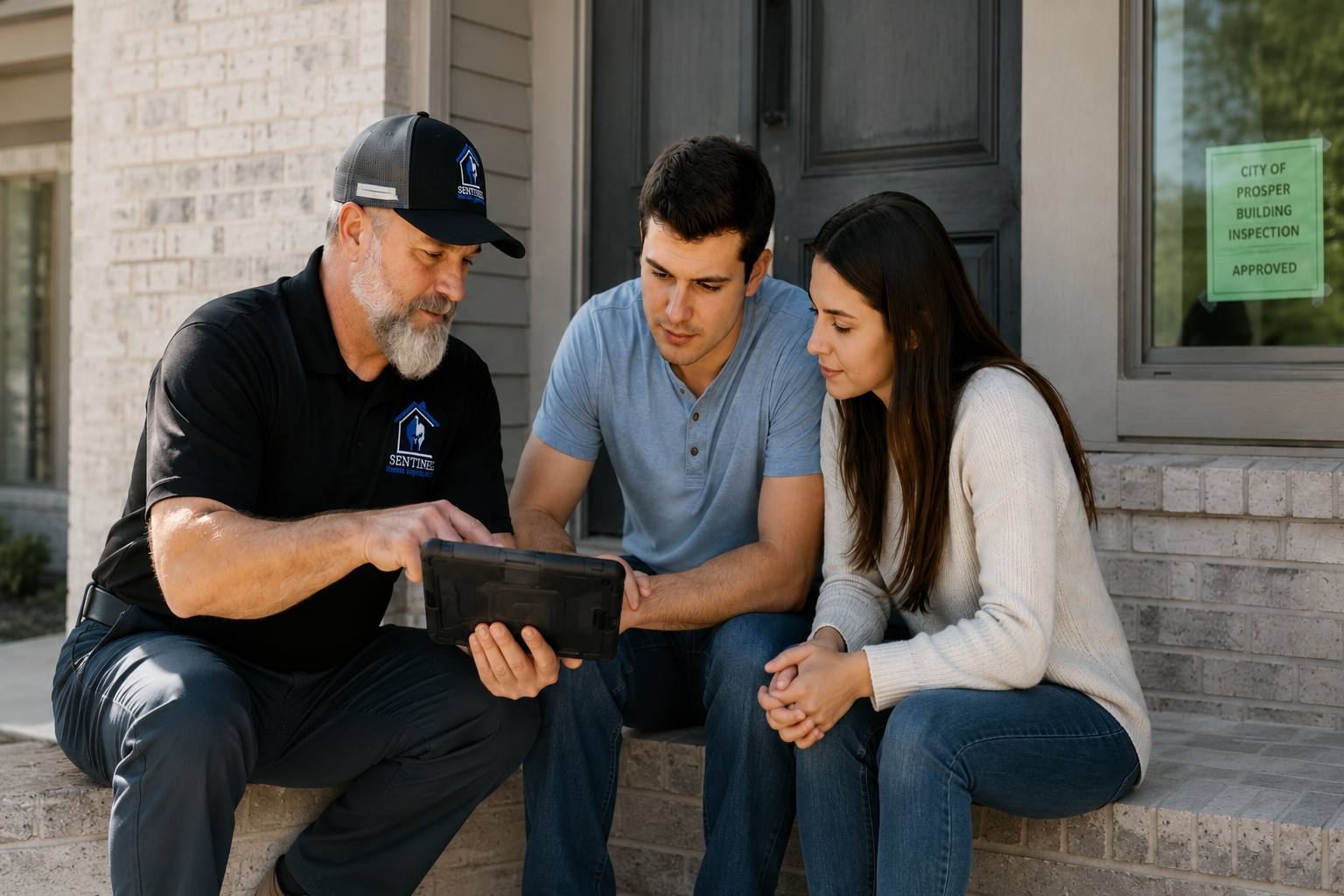
The Three-Phase Approach
The most critical defects in new construction are often hidden before the house is ever finished. That is why the best time to inspect is not just at the end. It is throughout the process.
Phase I:Pre-Pour Before the concrete foundation is poured, we inspect the foundation preparation, plumbing rough-ins, rebar placement, moisture barriers, cable chairs, and form integrity. Once that concrete is poured, anything wrong underneath it is buried permanently.
Phase II: Pre-Drywall Before the walls are closed up, we inspect the framing, electrical wiring, plumbing lines, and HVAC ductwork. This is when we find the crushed ducts, the severed wires, and the improper framing that will never be visible again once the drywall goes up.
Final Inspection:A comprehensive evaluation of the finished home before closing, including that HVAC differential temperature test. This becomes your punch list, a documented record of every item the builder is responsible for correcting before you take ownership.
The Bottom Line
Buying a new home in Prosper or Celina is one of the largest financial decisions you will ever make. The builder has a team looking out for their interests and their timeline. You need someone looking out for yours.
An independent inspection is not about assuming the worst. It is about knowing exactly what you are buying and having the documentation and the leverage to make sure it is right before you close.
If you are under contract on a new build in Collin County or anywhere in the DFW area, schedule your inspection with Sentinel Home Inspections before your closing date. The earlier in the process, the better.


