What a Thermal Imaging Scan Actually Shows (And Why We Use It)
What a Thermal Imaging Scan Actually Shows (And Why We Use It)
When you walk through a home, your eyes can only tell you part of the story. You can see the condition of the paint, the quality of the flooring, and the layout of the rooms. But the most critical issues in a home are often hiding just out of sight, buried behind drywall or tucked into ceilings.
That is why we utilize thermal imaging technology on our inspections. An infrared camera allows us to see temperature differentials across surfaces. It does not give us x-ray vision to see through walls, but it does show us the heat signatures of the materials behind them.
We use thermal imaging for two primary reasons: evaluating insulation and hunting for hidden moisture.
Checking the Insulation
In both new construction and older homes, proper insulation is vital for energy efficiency and comfort in North Texas.
We use the thermal camera to check for the presence or lack of insulation in the walls and ceilings. In older homes especially, insulation can settle over time or become compacted, losing its R-value and effectiveness. The camera will clearly show us cold spots in the winter or hot spots in the summer where the insulation is missing or failing, allowing us to pinpoint areas that need attention.
Hunting for Hidden Moisture
The most important use of thermal imaging is detecting moisture issues that are completely invisible to the naked eye. Water is the enemy of a home. If it gets inside a wall cavity, it will eventually cause rot, structural damage, and mold.
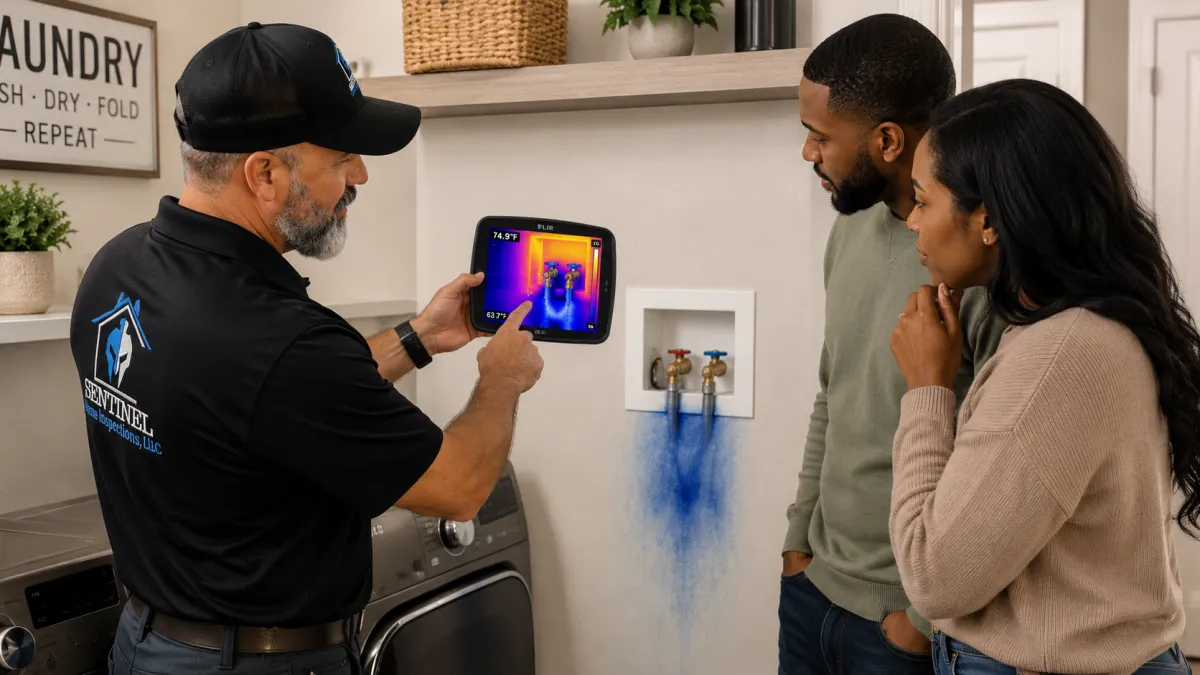
We systematically scan the walls and ceilings, paying special attention to the areas behind and around plumbing fixtures. Recently, we were inspecting a home and scanning the laundry room. The water line connections for a washing machine typically come up from the foundation into a box in the wall that houses the hot and cold valves.
To the naked eye, the wall around the washer box looked perfectly fine. The drywall was intact, the paint was clean, and there were no water stains or bubbling.
But when we viewed that same wall through the thermal imager, a completely different picture emerged. The screen showed a distinct, dark blue heat signature spreading downward from the valve box. That lower temperature indicated an area that was saturated with moisture. Water was leaking from the connection inside the wall and soaking the drywall from the back.
Because we found the moisture early, we were able to determine that mold had already started to grow behind the wall. By identifying the issue before the buyer closed on the home, we saved them a significant amount of money and the headache of a major remediation project.

Seeing the Unseen
A thermal imaging camera is a powerful tool, but it requires a trained professional to interpret the results correctly. Not every cold spot is a leak, and not every hot spot is missing insulation.
When you hire Sentinel Home Inspections, you are getting the benefit of advanced technology combined with the experience to know exactly what those images mean for your home.
Do not rely on just what you can see. Schedule your inspection with Sentinel Home Inspections and let us show you the full picture.
Kyle Hamilton is a TREC Licensed Inspector and InterNACHI Certified Professional Inspector serving the Dallas-Fort Worth area. Sentinel Home Inspections LLC | License #25351.


